We read the deck end-to-end. The thesis is the right shape for India in 2026 — APAAR + ABC + DigiLocker just landed mandatory rails, NAAC/NIRF placement pressure is real, AI-assessment funding is up 273% YoY, and no incumbent fuses college SaaS + skill verification + reputation + marketplace under one composite score. The job is to ship it carefully — composite scoring for students is a regulated surface, not a hackathon.
Surya AI Technologies is a small, founder-led applied-AI studio based in Bengaluru. We ship products end-to-end — engineering, design, infrastructure, and pedagogy — rather than handing slides to integrators. Below is the one-screen snapshot, then the two of us.
| What we do | India-first applied-AI products across EdTech, enterprise AI, and AI dev tooling — with a heavy bias toward shipped artifacts you can open in a browser. |
| How we work | Compact founder-led team, weekly shipping rhythm, every claim backed by a working artifact you can open in a browser. |
| Active products | Saathi AI (student companion · EdTech), DevPilot (AI dev platform), EnquiryPilot & QuickBillPro (SMB AI tooling), Dhanvantari LIS (clinical AI). |
| Founders | Kishore Rajendra (engineering, product) · Soumya Swain (co-founder). |
| Status | Incorporated, lean, customer-funded. No outside capital. |
| Get in touch | kishore@suryaai.co.in |
Parth introduced us to Naveen, who shared the BeeTrustScore product deck — an AI-powered student trust & employability ecosystem positioned as a "CIBIL-like 0–1000 score for students," with a verified-skill engine, social reputation layer, college dashboard, and internship marketplace.
"Fake certificates and inflated resumes. No practical employability measurement. Limited student credibility systems. Poor hiring visibility for recruiters." — the four problems the deck opens with.
This is the right framing for India in 2026. The student-credential market just shifted under everyone's feet: APAAR ID + Academic Bank of Credits + DigiLocker became mandatory for every higher-ed student in June 2025. That creates a verified-credential anchor that nobody has built the trust-and-reputation layer on top of yet. The job is to ship that layer carefully — composite scoring for students is a regulated surface.
This document is our take on what's strong in the thesis, what the deck doesn't yet surface, and three concrete shapes for how we could build it together. No commercial ask. Conversation first.
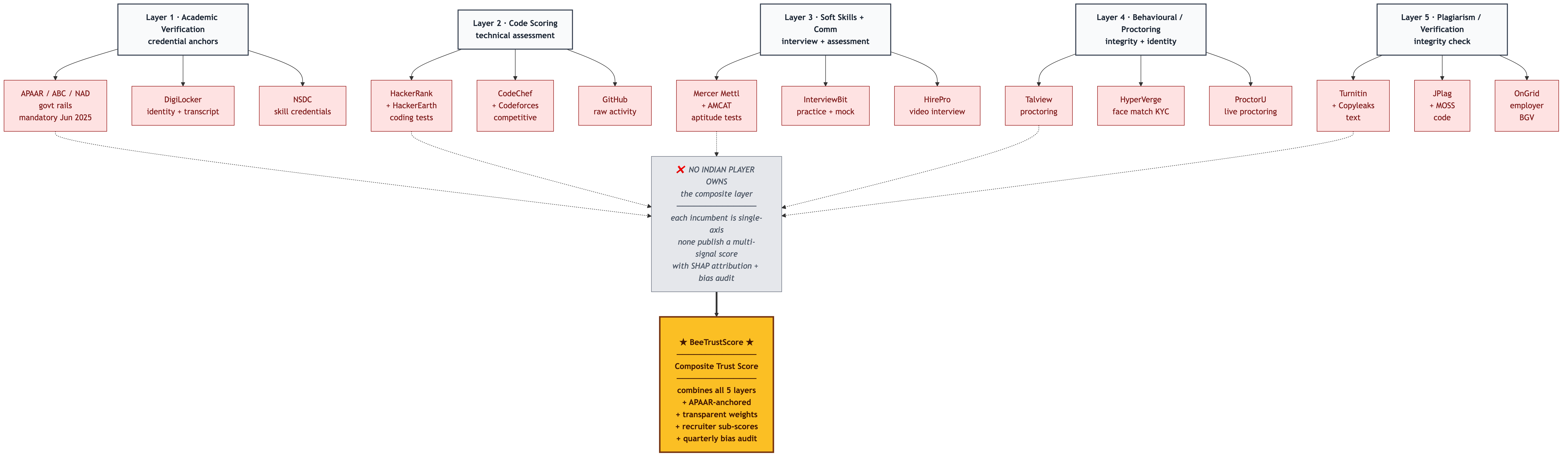
We mapped BeeTrustScore against the India landscape. The closest single analogue we found is the combination of Superset (placement SaaS) + Unstop (reputation-by-competition) + Internshala (marketplace) + AMCAT (assessment) — but no incumbent fuses all four under a composite trust-score frame. That's a genuine white space, and the timing is unusually favorable.
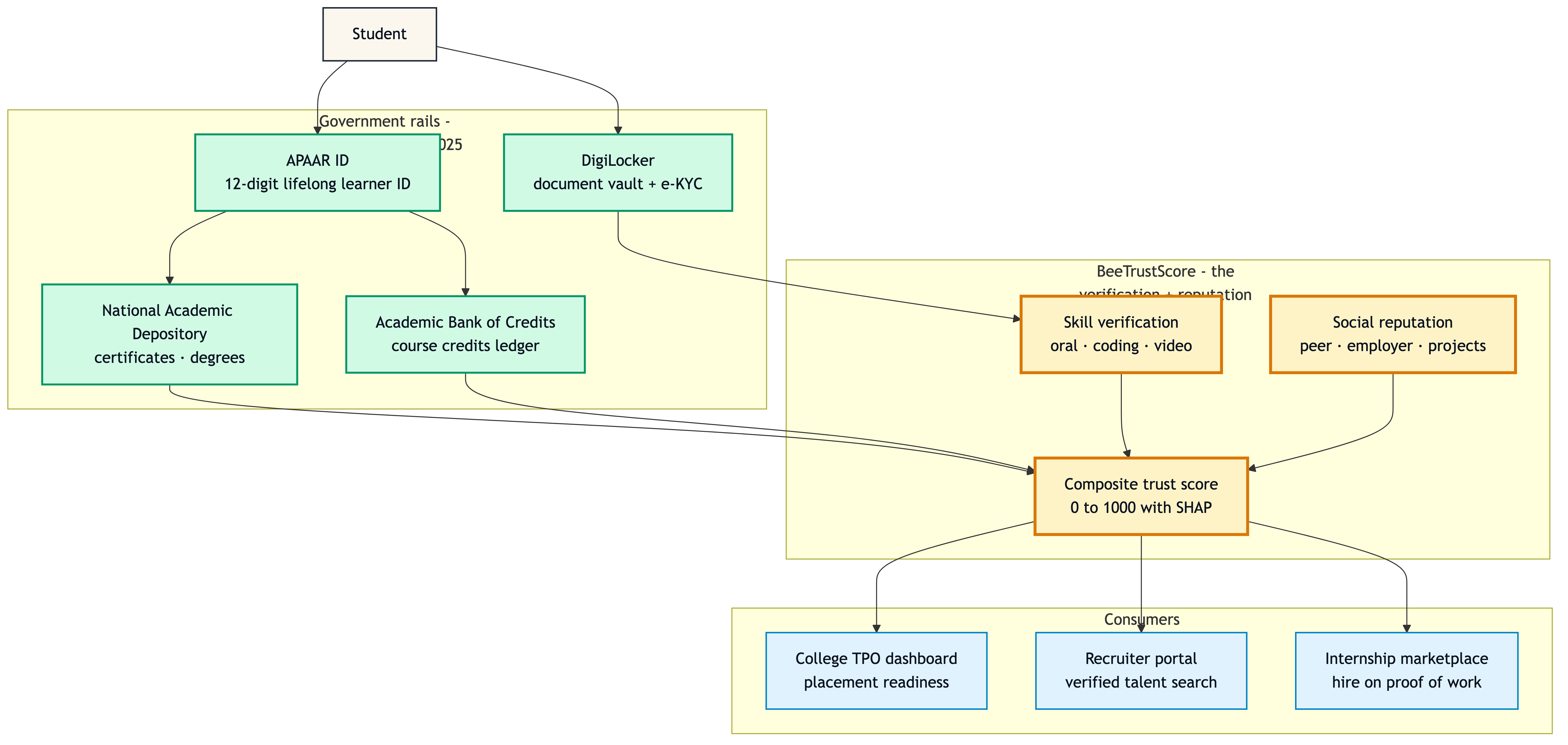
APAAR + ABC + DigiLocker became mandatory for higher-ed in June 2025. BeeTrustScore can anchor as the layer on top of APAAR — verified credentials become the trust signal, BTX layers reputation + skill verification + composite score.
EdTech AI funding in India was up 273% YoY in Q1–Q2 2026 (Tracxn). 31% of global EdTech funding in 2025 went to AI-powered learning + assessment startups. Talview shipped agentic-AI proctoring in 2026 — the tech-readiness arrived.
NAAC/NIRF placement-rate scoring has been tightening every year. Engineering admissions hit an 8-year high in 2024–25 (lowest vacancy in years). Colleges are under real pressure to invest in modern placement tech — a SaaS deal at ₹5–15 lakh/year per college is plausible.
We mark these P0 / P1 in the spirit of a build partner reading the deck closely, not a critic. Each is a 4-week to 6-week work item, not a year. None changes the thesis; all change the sequencing.
DPDP Act 2023 Section 5 requires separate, specific, informed consent for biometric data — video assessments fall under this. Bundling video-consent with general T&Cs is invalid. Section 9 mandates verifiable parental consent for any student under 18 (most first-year college students). Fines top out at ₹250 crore (general) and ₹50 crore (biometric-specific). Enforcement timeline: full operationalisation by 12 May 2027.
Separately, UGC/AICTE has no explicit guidance permitting or prohibiting third-party student scoring — a gray zone that could close either way after 2026. A "ranking individual students" framing is fragile; a "peer feedback aggregation + verifiable signals + DigiLocker-backed credentials" framing is defensible. Both are addressable in v1 design: granular per-purpose consent UI, DPIA published annually, DPO appointed, retention policies aligned. We treat this as architecture, not afterthought.
India has no Title-VII-equivalent algorithmic-bias statute, but Constitution Articles 15 & 16 prohibit discrimination on caste, gender, religion, place of birth — and case law extends this to disability and language. If the composite score proxies any protected characteristic (caste-via-surname, gender, accent-via-language, disability-via-video-gait), recruiters relying on the score and BeeTrustScore as provider face indirect-discrimination exposure.
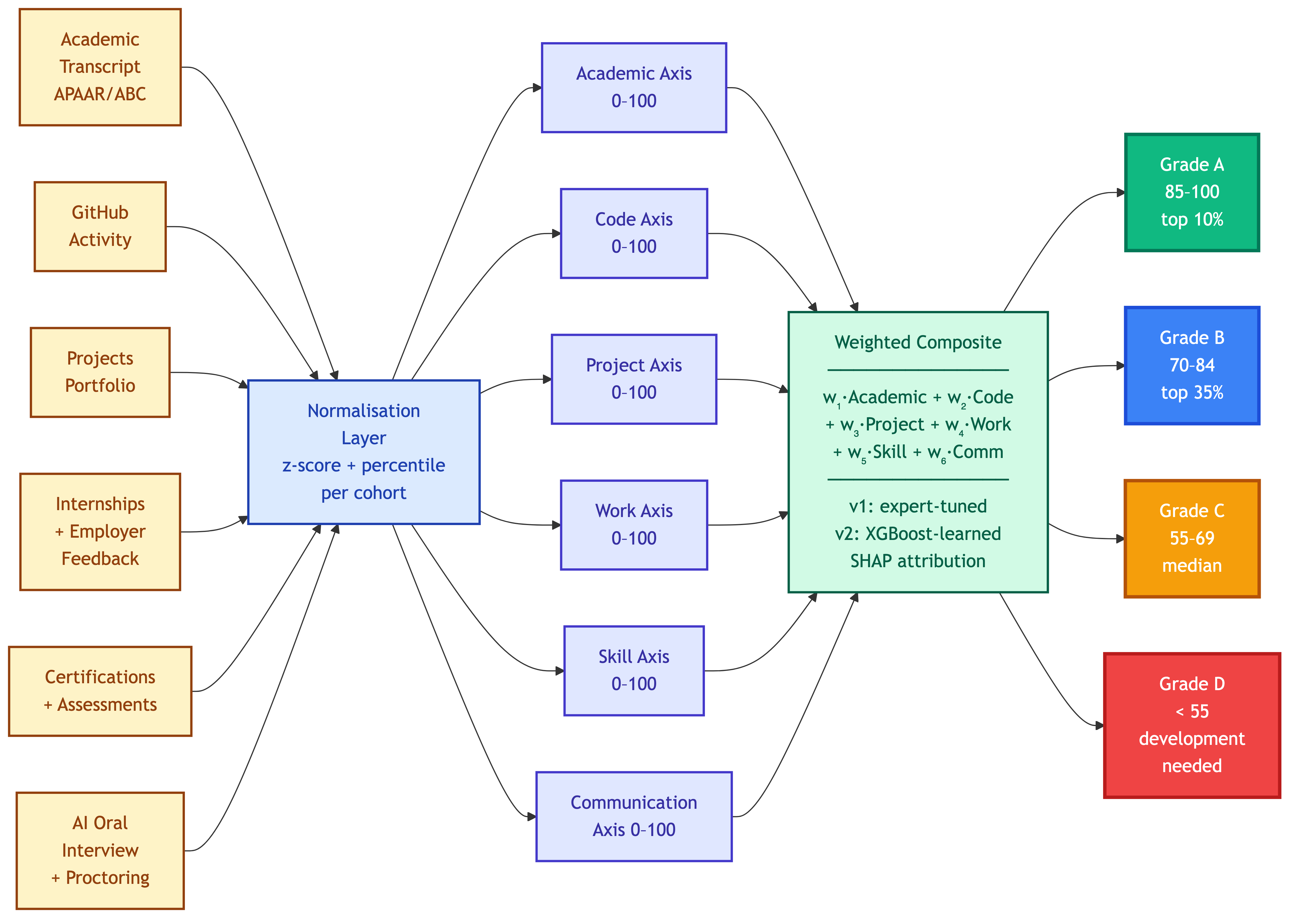
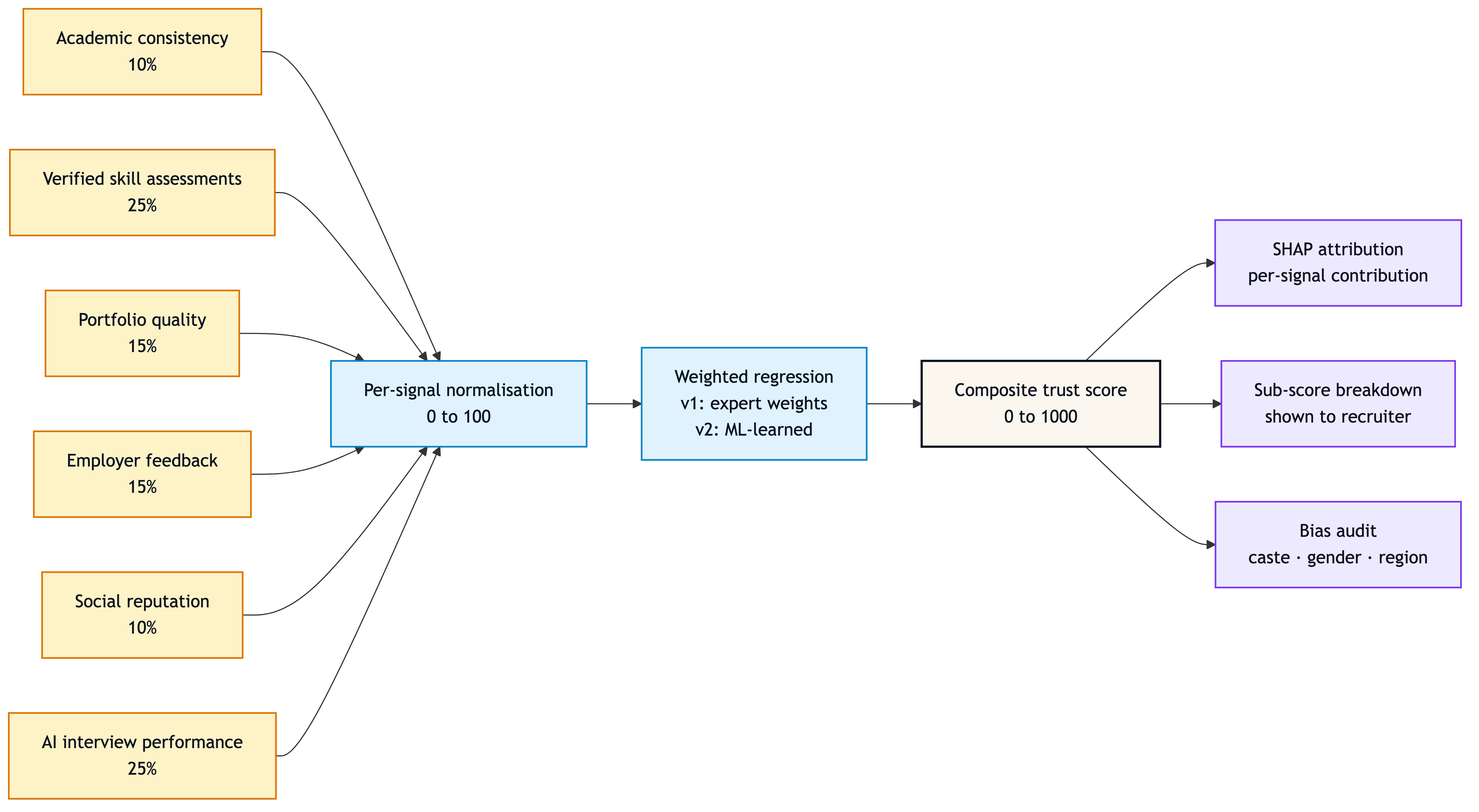
The defense is structural: SHAP-based explainability so every score is decomposable, a documented bias audit cadence (caste / gender / region disaggregation), and a recruiter UI that shows sub-scores ("fluency 87, coding 72, plagiarism risk 3%, employer reviews 4.6/5") rather than just an opaque 812/1000. A composite without decomposition is the failure mode.
The deck lists five revenue streams — college SaaS, recruiter premium, student premium, hiring commissions, sponsored hackathons. Trying to ship all five in parallel is the well-known failure mode for marketplace platforms (chicken-and-egg on both sides; thin liquidity everywhere; nothing genuinely working).
Our read: start with the college dashboard + composite score for one cohort (TPO-side wedge, well-defined buyer, ₹5–15L SaaS). Recruiter marketplace comes in v2, after there's a real score that recruiters can trust. Hiring commissions are a v3 line, not a v1 line. The deck has the right product vision; the sequencing matters as much as the vision.
The table below maps the five layers BeeTrustScore touches against today's incumbents. The right read is not "BTX competes with all of them" — it's "BTX integrates the signals incumbents publish, then layers a composite score none of them today publish."
| Layer | Today's incumbents | What BTX does differently |
|---|---|---|
| College placement SaaS | Superset (~600 colleges); Naukri Campus (1.5M students, 20k colleges) | Adds a per-student composite score + AI placement-likelihood predictor on top of the workflow incumbents already own. |
| Skill assessment | AMCAT / SHL (5M+/yr), eLitmus (2M+/yr), CoCubes, Mettl / Mercer | BTX rolls assessment into a continuous score; incumbents publish single-test percentiles only. |
| Internship marketplace | Internshala (25M users); Unstop (25M students, competition-led) | BTX hires-on-proof-of-work, with verified-score gating — vs. self-declared resumes today. |
| AI proctoring / interview | Talview (800+ enterprise, Alvy agentic AI 2026); iMocha; HirePro | BTX bundles proctoring into a multi-modal trust signal, not a standalone interview tool. |
| Government credential rails | APAAR + ABC + NAD + DigiLocker (mandatory June 2025) | BTX plugs INTO the government rails as verification anchor — layers behavioural + skill + reputation signals on top. |
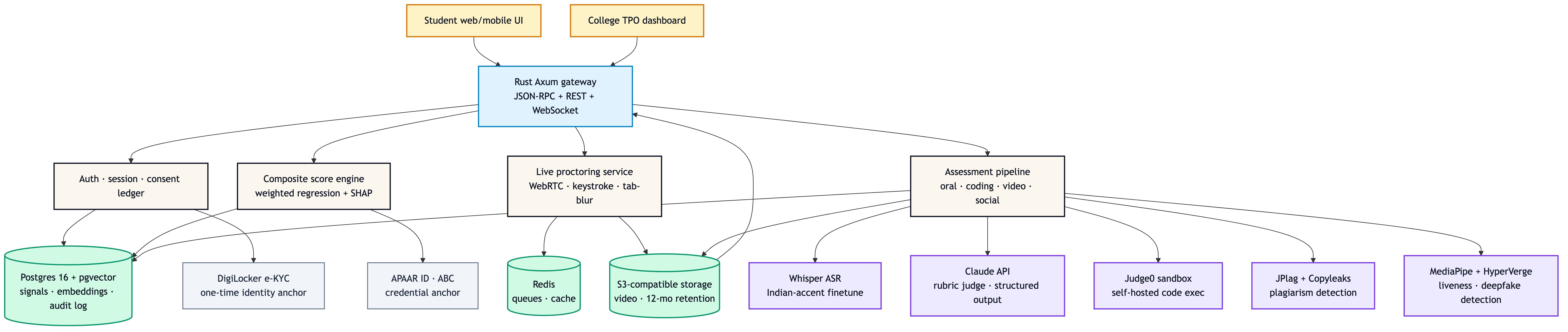
A v1 that can hold one pilot college and ~1,000 concurrent students costs roughly $5K/month in infra + API spend. The stack below is opinionated — privacy-first (code never leaves our servers), India-native (DigiLocker as identity anchor), and explainable from day 1 (SHAP attribution baked into the score, not added later).
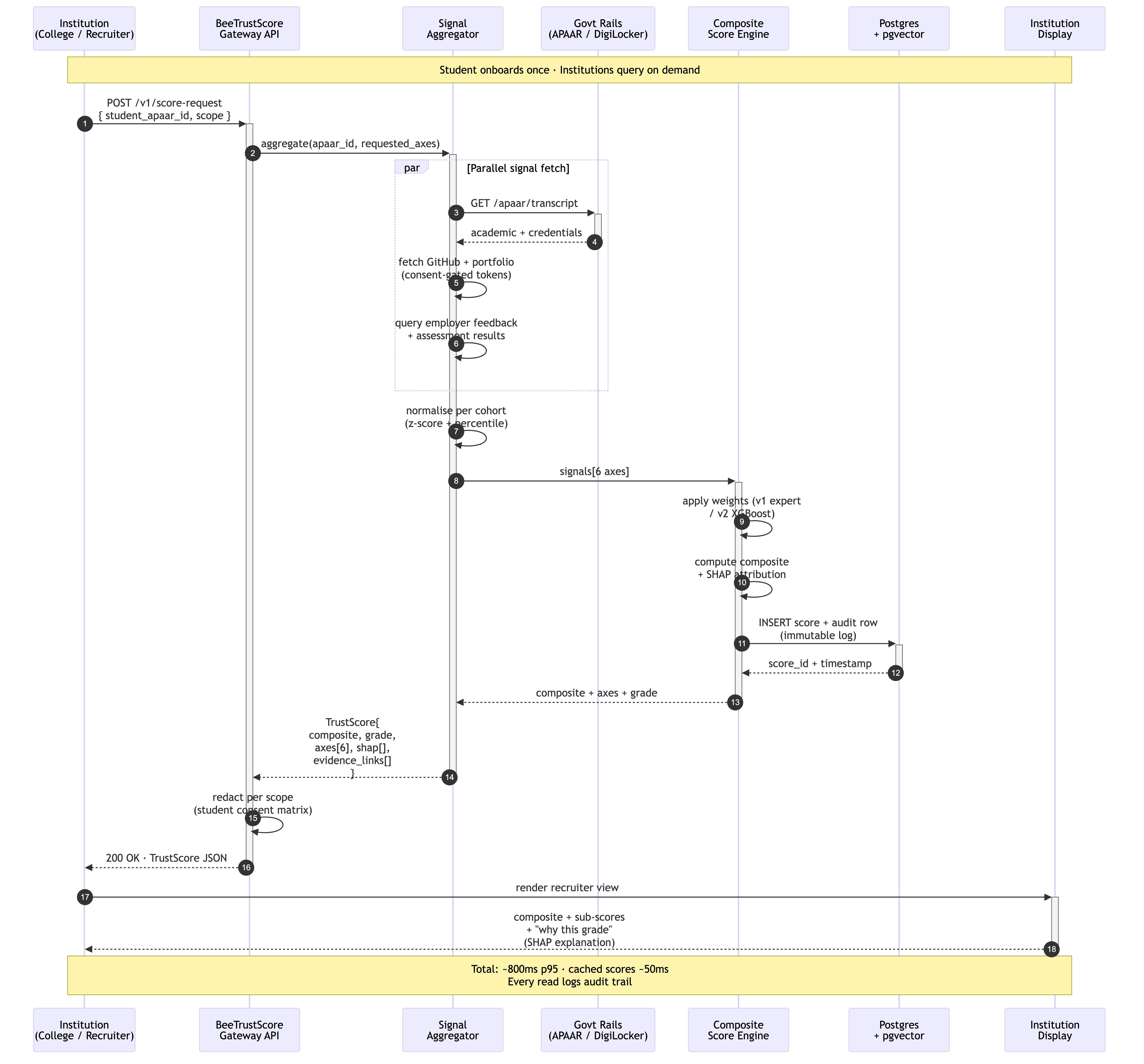
POST /v1/score-request with an APAAR ID. The aggregator parallel-fetches signals from APAAR/DigiLocker, GitHub (consent-gated), portfolio, and employer-feedback. Signals normalise per cohort, the composite engine applies weights + SHAP attribution, the score lands in Postgres with an immutable audit row, and the API returns a redacted TrustScore JSON the institution renders with "why this grade" decomposition. ~800ms p95 cold, ~50ms cached. Every read is logged.
Per our standard tiered-development discipline (GOLDEN-052): the v1 is the smallest version that's defensibly in market — not a demo, not a hackathon prototype. v2 proves the wedge after real data. v3 turns the wedge into bureau-scale infrastructure. The total runway from kickoff to a credible bureau positioning is roughly 18–24 months, gated by college pilot results, not by calendar.
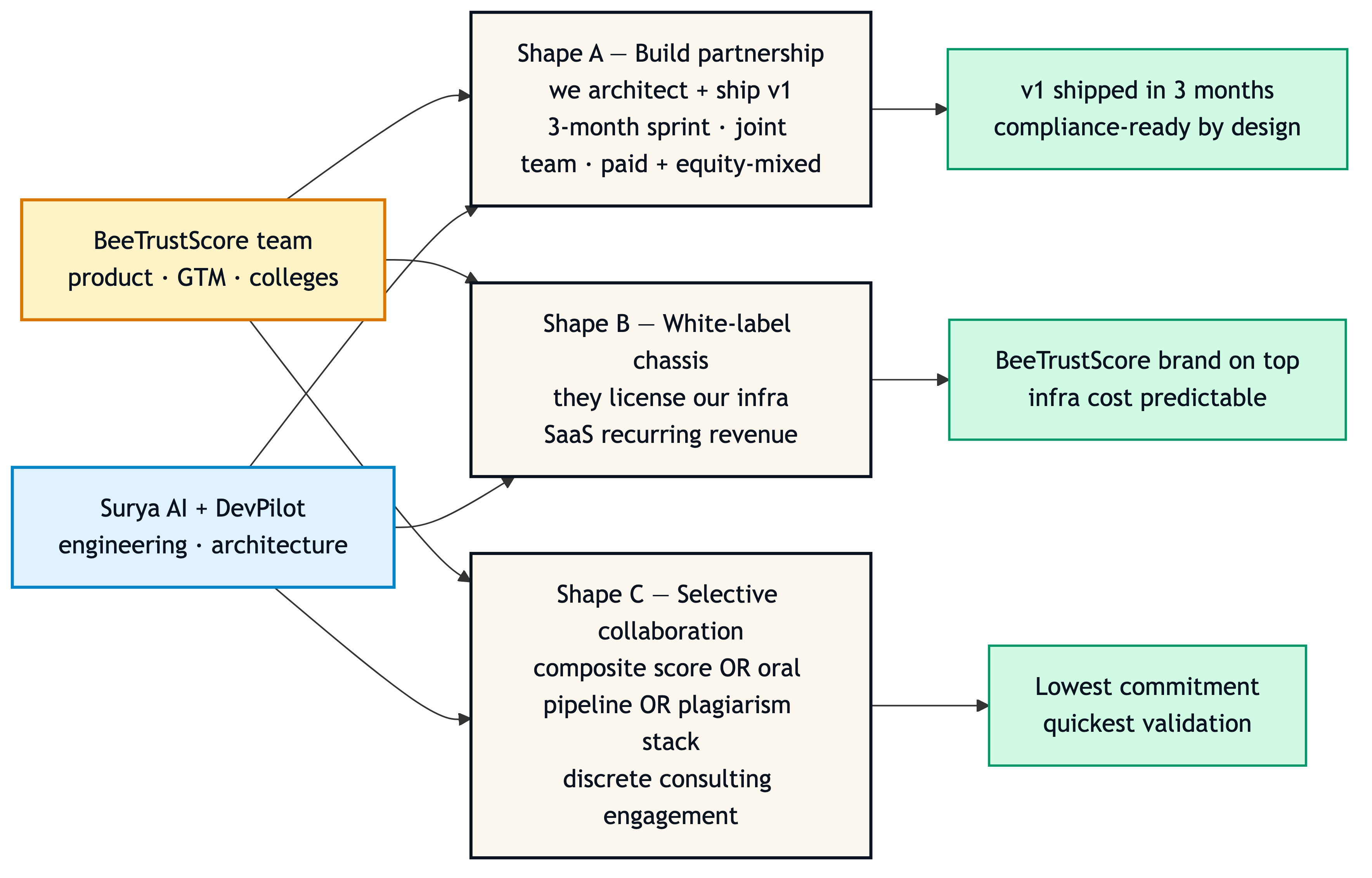
Build partnerships are not one-size — we offer three shapes, with different commitment + control + outcome profiles. Shape A is the most interesting given the architecture + compliance complexity. Shape C is the safest first step if there's not yet alignment.
A small high-performance team brings twelve months of build-platform R&D plus the shipping discipline we've taken into global-scale products. Composite scoring + audit + India rails are tailored on top of production-grade modules, not built from scratch. AI is an opt-in addon, never required for the deterministic score to work. And candidate / institution data sits under your keys, not ours.
You inherit Rust core + Postgres truth + signed-audit storage + India-native rails we run today. From-scratch equivalent for a defensible v1: ₹40–60L over four to six months, with first-attempt risk on the composite math and the audit chain. Our number is a discount against that baseline, not a markup against billed hours.
Day-30: a working composite score, fully deterministic. When the signal corpus has shape, switch on the AI layer for anomaly detection across candidate signals, narrative explanations of score deltas, and dynamic reports for institutional partners. AI never decides the score — it explains and surfaces, on your terms.
Encryption at rest, on-device encryption for identifiers, scoped access by role. Candidate raw signals never leave your perimeter to an external AI — only the minimal aggregates required, redacted. Every AI request is auditable: pause the layer, swap providers, run on-premise. A kill switch over a black box.
No commercial ask. We'd like to understand the founding team and traction, get your read on the regulatory framing, and decide together whether Shape A / B / C is the right starting point. If the answer is "not yet", that's also fine — we'll still know more than we do today.
Reply to set a time →Every market-size, regulatory, and competitive claim is sourced. We are deliberately conservative — nothing claimed here exists only on a slide.
| AISHE 2021–22 | India higher-ed enrolment, 43.3M students — source for the TAM framing in §02. |
| AICTE 2024–25 | 5,875 engineering colleges, 15.98 lakh seat intake — anchor for SAM count in §02. |
| UGC 2025 | 911 UGC-approved universities — addressable college base. |
| Tracxn / Inc42 H1 2025 | India EdTech funding signals; 273% YoY surge in Q1–Q2 2026 EdTech AI funding cited in §02. |
| DPDP Act 2023 + Rules 2025 | Section 5 (biometric consent), Section 9 (parental consent for minors), Rule 6 (DPIA), Rule 10 (educational exemption) — the regulatory base for §03 P0. |
| NEP 2020 / APAAR / ABC | National Education Policy implementation; APAAR ID + Academic Bank of Credits + DigiLocker mandatory June 2025 — anchor for §05 FIG 03. |
| Constitution Articles 15 & 16 | Anti-discrimination basis cited in §03 P1; case law extends to disability and language. |
| EU AI Act Annex III | High-risk classification for AI systems scoring student learning outcomes; applies if even one EU-based student or partner is in scope. v3 consideration. |
| Tools cited in §05 | Whisper (OpenAI), Claude API (Anthropic), Judge0, JPlag, Dolos, Copyleaks API, MediaPipe (Google), HyperVerge SDK, pgvector, DigiLocker dev docs. |
| Incumbents cited in §04 | Superset, Naukri Campus, AMCAT/SHL, eLitmus, CoCubes, Mettl/Mercer, Internshala, Unstop, Talview, iMocha, HirePro, HackerRank/byteXL — public web sources, May 2026. |
We are deliberately conservative in the body of this proposal: nothing claimed here exists only on a slide. Everything below is tappable.
| Saathi AI | Student companion product in our portfolio — closest adjacency to BeeTrustScore on the student side. Demo on request via kishore@suryaai.co.in. |
| DevPilot | Our internal AI dev platform — Rust core, Postgres-first, opinionated about explainability and audit trails. The architectural chassis we'd reuse for BeeTrustScore. Walkthrough available. |
| v1 architecture details | Open FIG 01 — every box in the diagram is a real production component we've shipped on at least one other product. |
| Composite score with SHAP | Reference implementation available. We can demo a composite-score endpoint that returns the score, per-signal contributions, and a recruiter-facing sub-score breakdown — same shape as FIG 02. |
| 30-minute call | Booking via kishore@suryaai.co.in. No commercial ask. We'd like to meet the team and align on the shape (A / B / C in §07). |
If anything in this proposal does not match what you see when you open the product or the references, that is a bug in our document, not a gap in the product — please tell us and we will fix it within the day.